 A Deer Cull If Wrong
by Baron Halpenny, LincsMag Editor.
Date: 15 March 2013
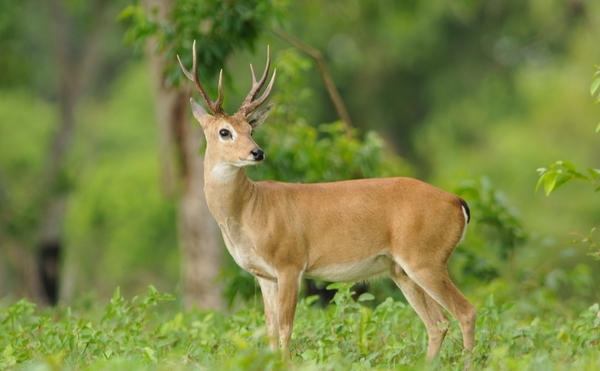
Roughly there are said to be around 1.5million deer in the United Kingdom, and the University of East Anglia say that unless numbers are managed, the deer population will escalate out of control. These experts say that the deer could become a serious problem ... becoming 'vermin', if numbers are not controlled now.
The authors, led by ecologist Paul Dolman, reported how they used infrared thermal imaging equipment at night to count roe and muntjac deer numbers around the Norfolk-Suffolk border, finding that deer densities were much higher than previously assumed, and a cull of half of the area's 3,500 muntjac deer and 60% of its 2,211 roe deer would be needed.
This urgency is also because deer are herbivores and can cause damage to Britain's ancient woodlands with their diet of native plants and wild-flowers that naturally can undermine the regeneration of woodland, threaten biodiversity and also affects other wildlife such as birds, with the nightingale and willow tit being particularly at risk.
As numbers increase, deer are forced out from woodlands and into other habitats including farmland where they cause still more damage.
They can also pose a danger to humans, particularly motorists as it is claimed that about 450 people are injured or killed on the roads and more than 14,000 vehicles are severely damaged as a result of collisions with deer every year.
No Natural Predator
The problem is that the deer have no natural predator due to the tampering of man, as a CLA spokesman admitted, “Man has caused this problem by removing the predators such as the wolf.”
A CLA East spokesman said: “The deer population in large areas of England is higher than the natural environment can support, leading to damage to woodlands and agricultural crops. The excellent research by the University of East Anglia has confirmed our belief that the current cull numbers are not enough even to retain deer numbers at existing levels let alone reduce the population to a level where it stops impacting adversely on the natural environment.”
Dolman, says that shooting deer at night with thermal imaging equipment by trained stalkers would be the most efficient and humane way of dealing with the deer problem. Yet a CLA spokesman told me that night shooting was not permitted. So a conflict there.
Dolman, who is reported to be a vegetarian, pointed out that the meat from the deer killed could be used to supply a thriving market in venison. This is a good point, and for those that eat meat, it is a very healthy and natural choice as it has not been injected with anything, or at least it shouldn't have.
Not All Are Happy
But proposals to cull such large amounts of deer in Britain has not pleased everyone and been denounced by gamekeepers who claim the move would also be a death knell for rural communities throughout the country, but with a much more profound effect on remote villages in Scotland.
The Scottish Gamekeepers Association said that such a massive slaughter of animals would destroy the livelihoods of thousands of individuals who support the deer-stalking industry.
However, Dolman has claimed that he didn’t say that up to 750,000 deer would have to be culled to prevent widespread ecological damage and that he only used those figures as hypothetical examples, which of course does mean that he did say those figures?
Dolman in fact admitted that they don't know how many deer there are in this country and that was the real problem that he was trying to get over.
"We cannot manage deer or control the damage they do until we get a proper estimate of their numbers. That is the real thrust of our research. We have found that our knowledge of deer population densities is much poorer than we previously thought." He said.
An Unclear Report
There could be problems with deer numbers increasing, but this is due again to man’s tampering as four of the six species found in the UK were introduced with the most recent arrival being the Chinese water deer that has only established itself in the last 100 years.
Remember also that this report by the University of East Anglia is of only two of the six species of deer in the UK. The worry here is that this report is also of only one particular area, which then guesses for the rest of the UK and the 50 to 60 per cent cull is only a guide for the Norfolk-Suffolk border area. Each area has to do it's own assessment.
This of course makes all the figures and culls being talked about pretty pointless until proper research on the true numbers are known. There does also seem to be conflicting elements in all this and really as it stands, I cannot see how the report can be entertained as there are too many loose ends.

