 iPod Oblivion
by Patricia Montgomery, LincsMag Writer.
Date: 08 August 2010

We've all seen them and it seems the Texting 'iPod Zombies' are on the march...
'iPod oblivion' – a trance-like or Zombie state entered by some people using MP3 players, phones and electronic organisers on the move – can be lethal for pedestrians, cyclists and car drivers.
There has been a marked increase in the number of 'iPod zombie pedestrians' and joggers oblivious to traffic around them as they cross busy roads.
It is thought that pedestrians' lack of attention may be a factor in some of the 500 pedestrian deaths or 26,887 pedestrian casualties last year.
Analysis from AA Insurance shows that pedestrian inattention could be the cause of 17 collisions* each day and notes that there has been a 5% increase in these type of collisions in the last year.

The Insurance Claims
More than half of AA Insurance claims involving a pedestrian include causes such as:
- Man on phone stepped out, wasn't looking
- Pedestrian just walked out
- She looked the wrong way
- He walked into the side of the car
About 20 per cent of these claims were where the driver swerved to avoid a pedestrian and hit something else, for example, another car, a bollard, or a lamp-post.
One swerved to avoid a pedestrian in the road but the car ending up in chemist's shop.
Excluded from the analysis were cases where the pedestrian was drunk, an attempted suicide or where the driver clearly was at fault.
Unintentional blindness
It appears that more people are using communication technology on the move:
The businessman crossing city streets checking emails
The tourist finding best restaurants on the latest smartphone app
The cyclist or jogger getting carried away to Motorhead
The company car driver plugged into Mozart
Use of such technology on the move can lead to 'unintentional blindness' or 'divided attention' which poses great risks for road safety.
The AA is particularly concerned at reports from patrols of people broken down on the hard-shoulder of motorways, pacing backwards and forwards whilst using mobile phones. This is incredibly dangerous with juggernauts passing just a few feet away.
Comment
Edmund King, AA President, said: "We can't stop the march of technology but we need to halt the 'iPod pedestrian, cycle and driver zombies'. Whether on two feet, two wheels or four, too many people are suffering from so-called 'iPod oblivion'.
"When on the move our brains have much to take in and using technological gadgets means that our brains can't always concentrate on so many things at once. This is when we walk into traffic, don't hear the truck or drive cocooned from the outside world."
And it's Global
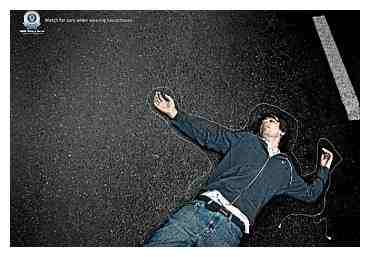
We can take comfort that we are not alone with this 'condition', the dangers of iPod pedestrians have been raised in other countries, most notably in Australia, where New South Wales police launched a graphic poster campaign.
It includes a series of posters showing people lying lifeless on the road with a white headphone cable snaking round their bodies like a chalk outline.
In the USA safety experts report people tripping on kerbs, walking into traffic, and stepping into manholes as they chat, listen or text whilst walking.
Technology is at hand to help with an earpiece that allows users to talk their text messages and applications which make a screen transparent.
A study from the Pew Research Centre in the USA shows that 17% of adults owning mobiles have bumped into another person or object due to be being distracted by talking or texting on the phone.
AA Insurance reports that more drivers making claims for minor shunts are citing 'podestrians' or iPod wearing pedestrians as the cause.
Sound Advice
The AA advises drivers not to wear headphones at the wheel and to be extra alert and slow down in areas frequently by pedestrians and cyclists.
The AA also advises those that use MP3 devices on the streets to ensure that the volume does not override their other senses.
* An examination of AA Insurance claims over the past year, up to 30 July 2010, shows that customers were involved in 177 pedestrian 'inattention' collisions. Of these claims one resulted in a fatality.
The rate is fairly static at between 12 and 16 per month. This is up 5% over the previous year. This is based on approximately 1m customers so if this was reflected in the driving population as a whole there could be more than 6,000 pedestrian 'inattention' collisions per year or 17 per day.

