 Marine and Coastal Day (2010)
by Patricia Montgomery, LincsMag Writer.
Date: 17 July 2010
The recent oil spill disaster by BP in America this year (2010) starkly reminds us of the importance of marine conservation, and the new Coastal Strategy brings together partners from across all sectors of the communities to help protect wildlife and to provide sustainable economic development along the coast.
A special event was organised by Marianne Overton on behalf of the Wildlife Trust and the Society of Biology, on the 10th July 2010 between 11am – 6pm, which was blessed with glorious sunny weather.
To find out more, a group of sixteen biologists were welcomed to the impressive Visitor Centre at Gibraltar Point near Skegness by Chief Executive of the Lincolnshire Wildlife Trust, Paul Learoyd.
Paul Learoyd gave an excellent introduction, outlining the significant importance of the Coastline and the vast amount being done to help protect it. Speaker Anthony Hurd is a marine biologist from the neighbouring Yorkshire and Humberside Wildlife Trust and a member of the Marine Advocacy Team for the North Sea.
Anthony picked out some brilliant marine species found along our world-class coastline and discussed the implementation of the recent Marine Act.
Dune Ecology
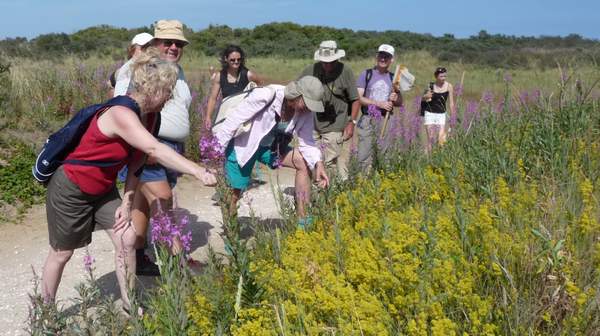
After lunch in the café the group enjoyed a guided tour of the rapidly developing dune ecology, led by Jane Southey.

A carpet of gorgeous sea lavender covered the salt marsh, gradually being superseded by sea Couch Grass. Brilliant pink pyramidal orchids, punctuated the matt of yellow rattle in the dune slacks with blossoming bunches of honey-scented ladies’ bedstraw and complementary Rosebay Willowherb decorating the dune edges. Sea Spurge, Sea lettuce and Sea Aster were common.
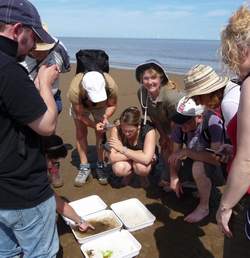
Sea dipping with the big marine drag net found a good number of species, though only one flat fish fry, a sole. The group that day identified two species of crabs, all male this time, so not suffering pollution, many tiny transparent fry and masses of shrimps, which are low in the foodchain.
A delicate comb jelly and ghost shrimps were also spotted too. Most exciting of all to the group was a very large mature Pipefish, like a straightened sea horse in beautiful gold armour and delicately fashioned. Smaller pipefish were in good numbers.

The fresh water pond dips highlighted the contrasting chemistry in each adjacent pond, each carrying significantly different invertebrates.
The bird life was highlighted by Peter Overton, BTO co-ordinator for West Lincolnshire. The hides were as revealing as ever, particularly the Jackson hide with its long strips of islands, providing plenty of edge for nesting birds.
Sandwich terns nested among the Black-headed and Mediterranean gulls, elegant Avocets were abundant and seven sulky egrets hunched against the hot sun.
There were also very good views of Bar-tailed Godwit, Redshank, Rough, Teal, swans, moorhens and coot.
It was a brilliantly beautiful day that was much enjoyed by all.
Details of the next events?
Interested in going to such an Event?
For details of the next events, contact Marianne Overton at:
marianne.overton@biosearch.org.uk.

