 Hotlips, Zipperback and Co
by Patricia Montgomery, LincsMag Writer.
Date: 01 August 2011
Ten species enter the English language for the first time as winners of the 2011 Name a Species competition are announced.
Emerging from obscurity, ten previously unnamed British species are now enjoying some long-awaited limelight as the results of the competition to give them popular names were announced last month (Thursday 21st July).
Thousands of people submitted entries in response to the Name a Species competition organised by The Guardian and Natural England. The competition invited the public to give popular names to ten British species that have until now been listed only in Latin.
The overall winner was ‘hotlips’ – Octospora humosa – a disc-shaped fungus that is a vivid orange-red and often resembles puckered lips. Among this year’s winners is the shimmering-ruby tail – nee Chrysis fulgida – a species of cuckoo-wasp named for its metallic-rainbow colouring. The fountain anemone, Ascot hat and scarlet lady were previously only known as Sagartiogeton lacertes, Xerocomus bubalinus and Coryphella browni, respectively. They now join the ranks of the more familiar bluebell, bladderwrack and Devil’s coach-horse, having popular names that describe their characteristics.
Dr Pete Brotherton, Head of Biodiversity for Natural England, said: “This competition set out to inspire the nation, drawing attention to some less well-known species that have, until now, been without a common name. The public have come up trumps with some vivid and imaginative suggestions to rescue these forgotten species from obscurity.”
Winning Names
The ten winning names are:
- Shimmering ruby-tail (Chrysis fulgida): A shiny bright wasp
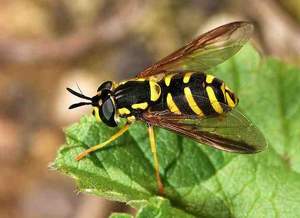
- Zipperback (Chrysotoxum elegans): One of nature’s gardeners
- Hotlips (Octospora humosa): A red high pressured fungus
- Ascot hat (Xerocomus bubalinus): A tree-nurturing mushroom
- Sunburst lichen (Lichenomphalia alpina): A lichen that thinks it’s a mushroom
- Neptune’s heart sea squirt (Phallusia mammillata): Britain’s largest sea squirt
- Scarlet lady (Coryphella browni): A recycling seaslug
- Fountain anemone (Sagartiogeton laceratus): A many tentacle anemone
- Serpent’s table brittlestar (Ophiura albida): A snaky star in the sand
- Gangly lancer (Nymphon gracile): An undersea spider with a straw
The ten new species names were selected from over 6,000 entries by a panel of five judges: Dr Peter Brotherton of Natural England, Dr Keith Hiscock of the Marine Biological Association, Liz Holden of the British Mycological Society, Matt Shardlow of Buglife and George Monbiot author and Guardian columnist.
Dr Brotherton continued: “Biodiversity is the foundation of our own existence and we cannot afford to take it for granted, which is why we are getting the issue out from under the microscope and into the limelight. We’re delighted that this competition has continued to inspire the public’s imagination and encouraged so many to find out more about the amazing range of wildlife we have in this country.”
Adam Vaughan, editor of environmentguardian.co.uk, added, "The fact that a 12 year-old girl won the Name a Species competition puts paid to the lie that today's young generation are not interested in nature. By dubbing a fungus with the witty, memorable and salient name of 'hotlips', Rachael Blackman has probably done more for the conservation of Octospora humosa than any naturalist before her. The quality of this year's entries was superb and I hope Neptune’s heart sea squirt, the gangly lancer, and shimmering ruby-tail will soon find a place in our collective cultural memory."
This is the second year of the competition, which was originally inspired by Natural England’s Lost Life - a report that showed that nearly 500 species have become extinct in England in the last 200 years – and the subsequent call by George Monbiot, author and Guardian comment writer, for a competition to enable the public to become more familiar with the species that we are in danger of losing.
About The Species
Shimmering ruby-tail (Chrysis fulgida)
This bright, metallic wasp belongs to the ruby-tailed wasps. It prefers heathland sites and although common in parts of Europe, is endangered in Britain, being confined to Surrey and Hampshire.
It is a parasitoid wasp – parasitoid insects differ from “true” parasites in that their hosts are always killed. This wasp lays its eggs in the nests of one other species of wasp and a species of bee.
Zipper-back (Chrysotoxum elegans)
Hoverflies feed mostly in pollen or nectar and so are commonly seem hovering around flowers. Their larvae prey on aphids and other plant sucking insects, and can therefore be useful to farmers and gardeners in controlling pests.
This species prefers dry, open grassland and is mainly found around the south west coastal peninsula and south west Wales. It is thought that the larva develop in ant-nests where they feed on root aphids.
Hotlips (Octospora humosa)
This bright, reddish-orange fungus is one of the Ascomycota – the spore-shooting fungi. These fungi produce microscopic spores inside special, elongated sacs. As the spores mature, pressure builds inside until eventually the top bursts off, “shooting” out the spores.
Octospora humosa is thought to live within with certain types of hair moss. The connection between the two species is not clear, but the fungus does not appear to harm the plant.
Ascot hat (Xerocomus bubalinus)
Xerocomus bubalinus has recently been recognised as being new to Britain, being first recorded in England near Ascot - it seems to particularly like growing with lime trees with which it shares a mutually beneficial relationship.
Threads from the fungus penetrate the roots of the tree and an exchange of nutrients between the species takes place. The fungus scavenges in the soil for mineral salts and in exchange the tree gives the fungus carbohydrates and sugars.
Sunburst lichen (Lichenomphalia alpina)
This unusual lichen has a conspicuous mushroom-like reproductive structure which, at first sight, does not look like it could be a lichen at all.
This bright yellow cap can grow 5-15mm across. The main body of the lichen consists of a thin, green, granular layer of algae mixed with fungal growth which forms around the mushroom stalk. Lichenomphalia alpina occurs on peaty soils, usually in upland areas, throughout the British Isles.
Neptune’s heart sea squirt (Phallusia mammillata)
Adult sea squirts have an unusual circulation system in which blood is pumped in one direction for several seconds and then in the opposite direction for the same length of time.
This species has a tough, leathery “tunic” that is milk-white in appearance. It’s the largest British sea squirt growing up to 12 cm long – large enough that small anemones can sometimes be found living on it.
Scarlet lady (Coryphella browni)
Sea slugs are also known as nudibranchs as they have no plates or cavities to protect their gills – nudibranch means naked gill. Most species have no protective shell and instead have evolved other means of defence – some have glands that secrete irritants and toxins.
This species feeds on stinging hydroids – tiny jellyfish-like creatures - and is able to recycle their stinging cells.
After ingesting the hydroid it passes the stinging cells to the tips of its tentacles where it uses them for defence. Coryphella browni grows to a length of up to 5 cm.
Fountain anemone (Sagartiogeton laceratus)
Anemones are primitive animals consisting of a column with a single opening for ingesting food and expelling waste. They are protected by stinging cells in the tentacles and across the body. This species grows up to 6 cm tall.
Its tentacles are arranged in 4-5 rings and can number up to 200. It lives below low-tide level and can be found down to depths of 100m. It favours sites sheltered from strong wave action and can be found along the the west coast of Britain.
Serpent’s table brittle-star (Ophiura albida)
At up to 14cm across, this is one of the smaller species of sand brittlestars. It is easily identified by two white spots at the base of each of its arms. Brittlestars move by gripping a surface with their tube-feet and using snake-like motions of their arms to move themselves along the seabed.
This species prefers silty conditions and can be found right around the British coast.
Gangly lancer (Nymphon gracile)
Sea spiders are tiny – less than a 1cm long – and not really spiders. They are so small that they don’t need gills or lungs – oxygen circulates by direct diffusion. Although small, most species are carnivorous and feed on soft bodied prey.
A sea spider pierces its prey, such as an anemone, with its proboscis and sucks out nourishment. The difference in size between predator and prey means that the prey usually survives the attack.

