 Sweet and Sour
by Baron Halpenny, LincsMag Editor.
Date: 18 December 2011

Why it’s enough for those in the industry to be driven to binging on sweets at the sad news that stagnant sales for the European confectionery market have been consistent over the past four years.
It seems there is little sweet news for the European confectionery market at the moment as genuine consumer concerns surrounding health issues such as obesity and global confectionery prices are giving the confectionery market a challenging time.
The latest research on the sugar and gum confectionery market in Europe reveals that in the Big 5 European countries, sales of sugar and gum confectionery have remained stagnant over the past four years (2008-2011), from 8.6 billion Euros in 2008 to an estimated 8.9 billion Euros in 2011.
Sales particularly declined in the most mature markets such as Germany, which despite remaining the largest market in Europe has seen sales drop from 3.8 billion Euros in 2008 to 3.6 billion Euros (est.) in 2011.
Meanwhile, the UK market has remained stable at around 1.8 billion Euros both in 2008 through to 2011. Similarly, France has seen modest growth, from 1.4 billion Euros in 2008 to 1.5 billion Euros (est.) in 2011. In Spain and Italy, the market managed to post a growth, although one has to say modest, from 1 billion Euros (Spain) and 768 million Euros (Italy) in 2008, up to 1.1 billion Euros (est. Spain) and 795 million Euros (est. Italy) in 2011.
Not All Bad
However, it is not all bad news for the confectionery industry, as research shows that Europe has been active in new product launches for the sector, accounting for over a quarter (27%) of global sugar and gum new product launches during January 2011 to June 2011, down a small 1% on the previous six months (July/Dec. 2010).
Asia Pacific was the leading region in new product development during this period, accounting for 42% of total launches.
Sciolti Chocolates – A Lincolnshire Success Story
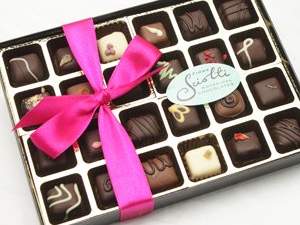
Many small-specialised producers and Artisan Chocolatiers are, unlike the sugar and gum confectionery market, continuing to grow in success. Lincolnshire is fortunately blessed in having fine quality producers, none more so than the wonderful Sciolti Chocolates where it is made very clear that Sciolti Chocolates is a natural product, using only the very best ingredients, locally sourced where possible. Real fruits, herbs, flowers, teas, local Roes Dairy Cream and honeys. If it says it's a raspberry chocolate, then it has real raspberry. Even the candied peels are made by the owner, Fiona.
Each chocolate ganache is lovingly hand cut, hand dipped and hand decorated by Fi. And she makes clear that she does not use the preformed bought-in empty chocolate truffle shells that many chocolatiers use, and won't be doing so in this millennium. She won't be popping any of her chocolates out a mould. Each chocolate is unique and has it's own artesian personality.
The Big Following The Small
The larger manufacturers and Conglomerates have not been slow in seeing the success of these Artisan Producers and their natural products, which have been growing a strong fan base, as now they too are introducing more natural ranges and eliminating or reducing additives and preservatives from their lines. The ‘no additives/preservatives’ claim was the second most popular across Europe during the six months to June 2011, accounting for around a fifth (20%) of the gum and confectionery launches, a figure which more than doubles the 9% seen globally.
Meanwhile, the ‘Low/no/reduced sugar’ claim dominates in new product development in the category, with over two in ten (22%) new launches with this claim over the past six months. The claim is however far more popular within the Gum confectionery market, with over half (56%) of new Gum products featuring the claim.
Pastilles, Gums, Jellies and Chews remain the largest sub-category in Europe at around a quarter (23%) of the launches for the review period, followed by Gum (14%), Toffees, Caramels & Nougats (12%), and Boiled Sweets (9%).
In particular, the sub-categories that saw above-average activity compared to the global market included Standard & Power Mints (8%), Liquorice (8%) and Medicated Confectionery (7%). With flavours it was the traditional flavours that remain extremely popular in Europe, of these the fruit varieties dominating the market (around 30%), followed by berry fruit (21%) and herbs (20%).
Whatever the Global and European market for confectionary may be, Lincolnshire can be proud of its Artisan Producers and the reputation they are carving out that is second to none.

