 The Car That Drives Itself ... And Other Gadgetry
by Tim Barnes-Clay, the man behind the wheel.
Date: 20 January 2011
A CAR is often essential for business and it is the main way of getting around for many people. But the choice of makes and models, not to mention countless trim levels, means that motor manufacturers need to come up with inventive technology to keep drivers buying their cars.
Always on the ball, LincsMag's 'man behind the wheel', Tim Barnes-Clay, takes a look at what sort of motor gadgetry is here and what is on the horizon.
Look, no hands!
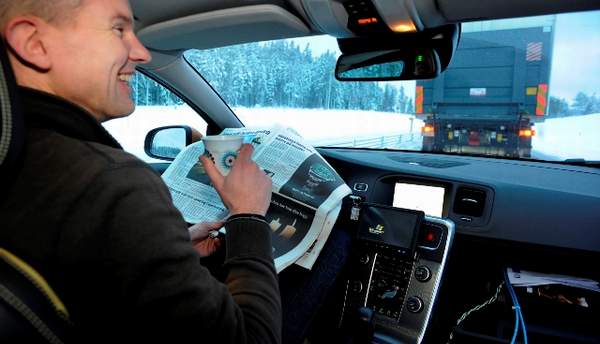
‘Platooning’ may be the new way of travelling on motorways in as little as ten years time – and the first successful demonstration of its technology has been carried out at the Volvo Proving Ground in Sweden.
Platooning is where a professional driver in a lead vehicle drives a line of other cars following behind. Each car measures the distance, speed and direction and adjusts to the vehicle in front. All cars are totally detached and as the steering wheel moves by itself the driver is able to drink coffee or read a paper, using neither hand nor foot to operate his vehicle.
Platooning is designed to improve a number of things: Firstly road safety, since it rules out the human factor that is the cause of at least 80 percent of the road accidents. Secondly, it saves fuel consumption and CO2 emissions. It is also convenient for the driver because it frees up time for other matters than driving. And since the vehicles will travel in highway speed with only a few meters gap, platooning may also relieve traffic congestion.
The technology development is well underway and could go into production in a few years time.
Talking tyres

Tyres capable of monitoring themselves, road conditions and ‘talking’ with a vehicle’s electronic systems will be available within a couple of years, heralding a revolution in traction technology.
The development is a quantum leap forward coming just a few years after tyres relied entirely on their physical properties for their contribution to a car’s driving dynamics.
Tyre Pressure Monitoring Systems (TPMS) introduced the concept of combining electronic sensors within a vehicle’s tyre and have proven to make a significant contribution to safety and fuel efficiency.
All cars will be fitted with this technology by law from 2012, but the arrival of the ‘talking’ tyre will push back the boundaries of technology further.
It all centres on a sensor mounted inside the tyre rather than on the valve or wheel rim as with current direct TPMS. The gizmo transmits information wirelessly to receivers mounted in the wheel housing and via the car’s ‘brain’ – the ECU - to the driver. This enables previously unobtainable data to be relayed to the vehicle’s electronic systems.
Information about the tyre’s tread depth, pressure and temperature, along with the shape of its footprint and the amount of load it is under, will be combined with precise readings of road conditions, such as the amount of grip available, to optimise control of the car’s dynamics.
The fully intelligent tyre, to be called the ‘Cyber Tyre’ is expected in the UK marketplace during 2013.
The App with a nose
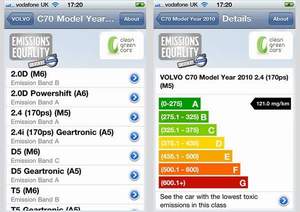
Volvo has invented a new App designed to sniff out the four main pollutants which impact air quality and health: carbon monoxide, oxides of nitrogen, hydrocarbons and particulates.
It is these toxic emissions that give the UK one of the highest asthma rates in the world and which the Environmental Audit Committee predicts will contribute to 50,000 premature deaths each year.
The Volvo App splits the noxious substances into seven bands - Band A includes cars with toxic emissions of between 0-275mg/km, rising to Band G cars with toxic discharges of over 600mg/km. By using the App, the driver can search for their make and model of car and a Best-In-Class button immediately identifies the motor with the lowest toxic emissions in that sector.
This data dispels the myth that small is always beautiful. For instance a Volvo V70 2.5 petrol manual estate generates 201mg/km of toxic emissions, compared with the 1.2 litre Fiat 500 Start Stop supermini, which at 425mg/km generates more than twice as many emissions as the Volvo.
The software shows the ‘dirtiest’ car on sale generates a hefty 2080mg/km of toxic emissions, with a number of others belching out over 1000mg/km.
By contrast the cleanest car in the UK is the Skoda Yeti 1.2 105PS which generates 49mg/km of emissions, followed by the Nissan Qashqai+2 2.0 4x2 (71mg/km) and the Honda Insight 1.3 IMA S/SE (73mg/km).
Volvo cars perform generally quite well, with the C70 2.4 170PS generating the lowest emissions (121mg/km – Band A) in the small sports sector, while the S40 D5 Geartronic sits in Band A of the Compact Executive Sector at 271mg/km.
The App is available for the iPhone and is available at HERE! once iTunes is downloaded onto a computer.

